
Ayurvedic Support for Children with ADHD, Autism & Childhood Anxiety
ADHD, Autism Spectrum Disorder (ASD), anxiety and sleep or behavioural difficulties can affect a child’s attention, communication, learning, emotional regulation and everyday family life. Management is rarely about one medicine or one therapy. A thoughtful plan considers the whole child — development, behaviour, sleep, digestion, sensory needs, family environment and overall health.
At ROG NIVARAN HOSPITAL, Ayurvedic care may be used as a complementary approach alongside appropriate pediatric, developmental, psychological, behavioural, occupational, speech or medical care. Depending upon the individual child, Ayurvedic management may include lifestyle and dietary correction, Medhya Rasayana, Shirodhara, selected Basti procedures and other physician-supervised therapies.

First, Understanding Your Child’s Condition
Parents often arrive with concerns such as poor concentration, excessive activity, delayed communication, repetitive behaviour, anxiety, disturbed sleep, irritability or difficulty coping at school. Similar-looking symptoms can have very different causes, which is why proper assessment is important.
ADHD — Attention-Deficit/Hyperactivity Disorder
ADHD is a neurodevelopmental disorder characterized by persistent difficulties with attention and/or hyperactivity and impulsivity that interfere with functioning or development.
- Difficulty sustaining attention
- Frequently shifting from one activity to another
- Excessive activity or restlessness
- Impulsive behaviour
- Difficulty following instructions or organizing tasks
- School and homework difficulties
Autism Spectrum Disorder (ASD)
Autism is a neurodevelopmental condition involving differences in social communication and interaction together with restricted or repetitive patterns of behaviour, interests or activities. Presentation varies considerably from one child to another.
- Communication or language difficulties
- Differences in social interaction
- Repetitive movements or behaviours
- Strong preference for routines
- Restricted interests
- Sensory sensitivities
Childhood Anxiety
Anxiety becomes clinically important when fear or worry is persistent, excessive and begins interfering with school, sleep, relationships or normal activities.
- Excessive worrying or fear
- Restlessness or irritability
- Difficulty sleeping
- School avoidance
- Physical complaints such as stomach aches or headaches
- Difficulty separating from parents in some children

ADHD and Autism are neurodevelopmental conditions. They should not be presented as conditions that can simply be “cured” by a single Ayurvedic medicine, Panchakarma procedure or supplement. The practical goal is to understand the child’s individual difficulties and support areas such as attention, sleep, emotional regulation, behaviour, digestion, daily functioning and overall wellbeing while continuing appropriate developmental and medical care.
Why Every Child Needs an Individual Assessment
Two children with the same diagnosis may have completely different needs. One child with ADHD may mainly struggle with hyperactivity and sleep, while another may predominantly have inattentiveness and learning difficulties. Similarly, children on the autism spectrum can differ greatly in language, sensory processing, behaviour and independence.
Therefore, before planning Ayurvedic supportive care, we consider:
- Age and developmental history
- Primary diagnosis and current symptoms
- Attention and activity level
- Speech and communication
- Learning and school performance
- Sensory sensitivities
- Sleep pattern
- Appetite and digestion
- Bowel habits
- Emotional and behavioural concerns
- Current medicines and therapies
- Ayurvedic Prakriti and relevant Dosha patterns
How Ayurveda Looks at the Child
Ayurveda does not directly equate modern diagnoses such as ADHD or Autism with a single classical disease entity. Instead, an Ayurvedic physician evaluates the child’s constitution, digestion, sleep, behaviour, mental characteristics and patterns of Dosha imbalance.
🌿 Vata
Vata is traditionally associated with movement, sensory activity and nervous-system functions. Features such as restlessness, irregular sleep, excessive movement or variable appetite may be considered when evaluating Vata involvement.
🔥 Pitta
Pitta is associated with transformation and metabolic processes. Irritability, heat-related symptoms or intense emotional reactions may be considered when assessing Pitta patterns.
🌱 Kapha
Kapha is associated with stability, nourishment and structure. Sluggishness, heaviness or certain patterns of reduced activity may be considered when evaluating Kapha.
The Ayurvedic treatment plan therefore depends on the child rather than the diagnostic label alone.
Role of Shirodhara
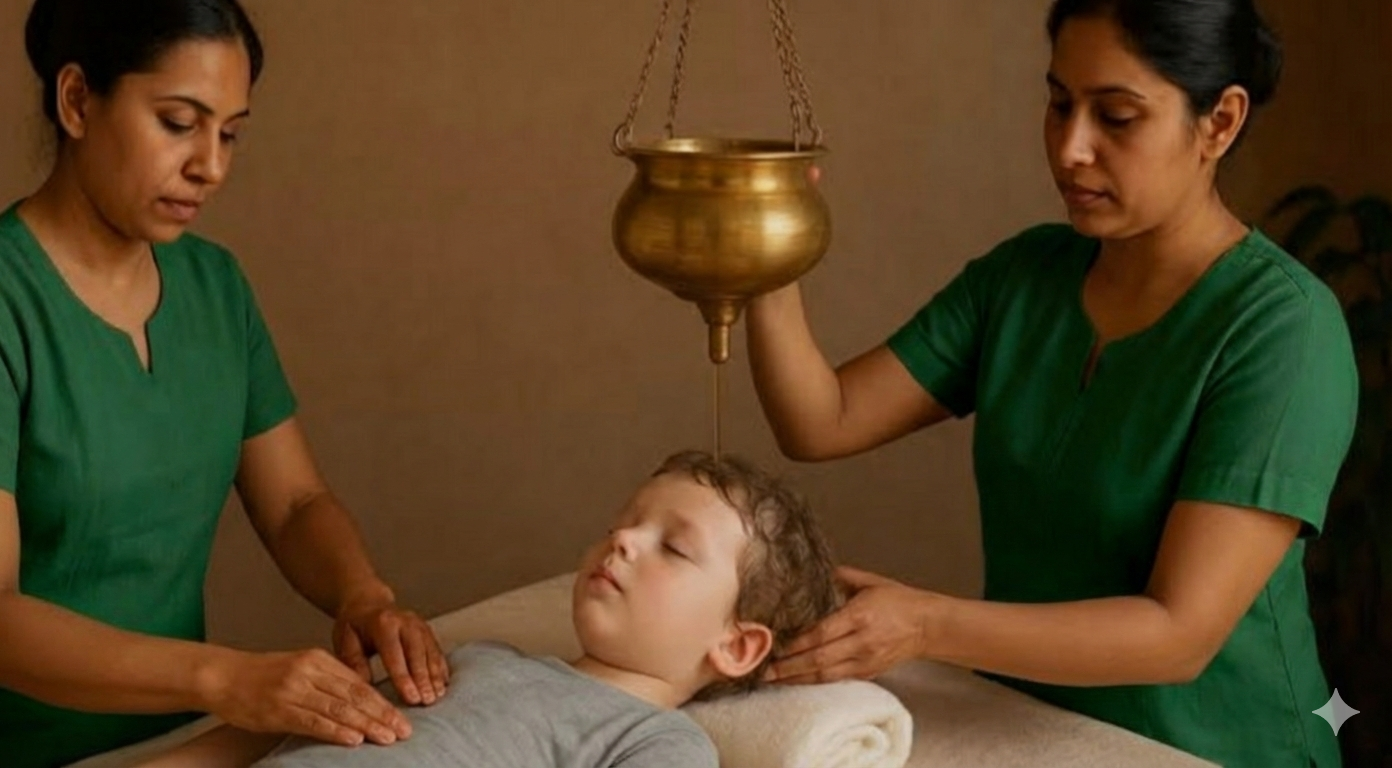
Shirodhara is an Ayurvedic procedure in which a controlled stream of an appropriate liquid, commonly medicated oil, is gently directed over the forehead for a specified period.
In children, Shirodhara should not simply be performed using an adult protocol. Duration, material used, temperature and suitability need to be individualized.
Why Might It Be Considered?
- To promote relaxation
- As supportive care for disturbed sleep
- To help a child settle during periods of excessive restlessness
- As part of a broader stress-management program
- To support a structured calming routine in selected children
Research on Shirodhara suggests possible relaxation and psychophysiological effects, but evidence specifically demonstrating treatment of core ADHD or Autism symptoms remains limited. It should therefore be considered an adjunct rather than a replacement for established care.
Role of Basti in Ayurvedic Supportive Care
Basti is an important classical Ayurvedic therapeutic procedure in which prescribed substances are administered through the rectal route according to a specific therapeutic protocol.
In Ayurveda, Basti has a particularly important relationship with Vata management. Because Vata is traditionally considered relevant to movement and many neurological functions, an Ayurvedic physician may consider carefully selected Basti therapy in an individualized treatment program.
Why Might Basti Be Considered?
- When Vata-dominant features are identified on Ayurvedic assessment
- When constipation or irregular bowel habits coexist
- As part of an individualized Panchakarma or supportive Ayurvedic protocol
- When nourishment or Vata-pacifying treatment is considered appropriate by the physician
Role of Viddhakarma
Viddhakarma is an Ayurvedic para-surgical technique involving controlled stimulation or puncturing of selected anatomical points by a trained practitioner. It is different from routine massage, acupressure or home-based stimulation techniques.
In contemporary Ayurvedic clinical practice, some practitioners use selected Viddhakarma approaches as an adjunct in neurological, pain-related or functional conditions. Its proposed role in children with neurodevelopmental or emotional concerns is based largely on Ayurvedic clinical practice rather than strong modern clinical evidence.
When Might It Be Considered?
- Only after detailed clinical evaluation
- Only when a specific therapeutic indication is identified
- As an adjunct to the child’s broader management plan
- With age-appropriate technique and strict hygiene
- Only by a practitioner appropriately trained in the procedure
There is currently insufficient high-quality clinical evidence to claim that Viddhakarma treats or reverses ADHD or Autism. Parents should view it as a specialized adjunctive Ayurvedic procedure rather than a substitute for developmental or medical therapy.
Medhya Rasayana & Ayurvedic Herbal Support
Ayurveda describes a group of approaches traditionally associated with Medha — intellect, memory and cognitive function. Depending upon the child, an Ayurvedic physician may consider herbs or formulations containing ingredients such as Brahmi or other Medhya Rasayana substances.
However, herbal treatment in children should never be chosen merely because a product is labelled “natural.” Age, body weight, digestion, concurrent medicines, formulation quality and the child’s individual health status all matter.
Daily Routine Is Often as Important as Therapy
For many children, consistent everyday habits form an important part of supportive management.
- Maintain consistent sleeping and waking times.
- Provide regular meals appropriate for the child’s nutritional needs.
- Encourage daily physical activity.
- Limit excessive recreational screen exposure, particularly before bedtime.
- Create predictable routines where helpful.
- Identify sensory triggers rather than simply labelling behaviour as stubbornness.
- Work with teachers and therapists to maintain consistency.
- Address constipation, poor appetite or significant sleep problems appropriately.
A Better Approach: Integrative Child Care
For ADHD, Autism and significant childhood anxiety, the most sensible approach is usually not “Ayurveda versus modern medicine.” Different children may benefit from different combinations of interventions.
The Child’s Care Plan May Include
- Pediatric or developmental assessment
- Behavioural interventions
- Speech and language therapy when indicated
- Occupational therapy when indicated
- Educational and school support
- Psychological support for anxiety
- Medication when clinically indicated
- Ayurvedic dietary and lifestyle guidance
- Selected Medhya Rasayana under supervision
- Shirodhara in appropriate children
- Selected Basti procedures when clinically appropriate
- Viddhakarma only in carefully selected cases
What Should Parents Expect from Ayurvedic Support?
Rather than promising a cure, progress should be monitored through practical goals relevant to the individual child.
- Is the child sleeping better?
- Is daily restlessness becoming easier to manage?
- Is attention during structured activities improving?
- Are bowel habits and digestion better?
- Is anxiety interfering less with daily activities?
- Is the child coping better with routines and transitions?
- Are parents and teachers noticing meaningful functional improvement?
Progress may be gradual, and the response to any intervention varies considerably between children.
Safety & Important Considerations
- Do not stop prescribed ADHD, anxiety, seizure or psychiatric medicines abruptly.
- Inform the Ayurvedic physician about all medicines and supplements the child takes.
- Ayurvedic formulations for children should be appropriately selected and dosed.
- Shirodhara, Basti and Viddhakarma require professional assessment and supervision.
- Children with seizures, significant medical disorders or complex developmental needs require additional caution.
- Developmental therapies should not be discontinued merely because Ayurvedic treatment has been started.
🧬 Understand Your Child’s Prakriti
Ayurveda recognizes that every individual has a unique constitution. Our online Prakriti assessment can help you understand the basic Vata, Pitta and Kapha characteristics of your child.
Take Free Prakriti AssessmentRelated Conditions & Ayurvedic Therapies
FAQs — Ayurveda for ADHD, Autism & Childhood Anxiety
1. Can Ayurveda cure ADHD?
ADHD is a neurodevelopmental disorder. Ayurvedic interventions may be considered as supportive care for selected symptoms and overall wellbeing, but parents should be cautious of claims promising a guaranteed cure.
2. Can Ayurveda cure Autism?
Autism is a lifelong neurodevelopmental condition with considerable variation between individuals. The goal of care is to support communication, development, daily functioning, health and quality of life rather than promise a simple cure.
3. Is Shirodhara safe for children?
It may be used in selected children when appropriately modified and supervised by a qualified Ayurvedic practitioner. It is not automatically appropriate for every child.
4. Can Shirodhara improve concentration?
Shirodhara may promote relaxation in some individuals, which can indirectly support sleep and the ability to settle. However, current evidence is insufficient to claim that Shirodhara itself treats the core attention deficits of ADHD.
5. Why is Basti considered in some children?
In classical Ayurveda, Basti has an important role in Vata management. A physician may consider it in selected cases based on the child’s Ayurvedic assessment, bowel function, age, strength and overall clinical picture.
6. Can parents perform Basti at home?
No pediatric Basti procedure should be started from online instructions. The formulation, amount, indication and method require professional assessment.
7. What is the role of Viddhakarma?
Viddhakarma is a specialized Ayurvedic procedure used by some practitioners as an adjunct in selected clinical situations. Evidence for its effectiveness specifically in ADHD or Autism is currently limited, so it should not replace established developmental treatment.
8. Can Ayurvedic treatment replace occupational or speech therapy?
No. When speech therapy, occupational therapy, behavioural interventions or educational support are indicated, they remain important components of the child’s care.
9. Should ADHD medicines be stopped when starting Ayurveda?
No prescribed medicine should be stopped or changed without discussing it with the clinician who is managing the child’s medication.
10. Are Brahmi and other Medhya herbs safe for every child?
Not necessarily. Herbal selection, formulation and dosage should take account of the child’s age, weight, digestion, medical history and other medicines.
11. How long does Ayurvedic supportive management take?
There is no fixed course applicable to every child. The duration depends on the child’s symptoms, treatment goals, associated problems and response. Progress should be reviewed periodically rather than promising improvement within a fixed number of sessions.
12. When should parents seek specialist medical help?
Seek professional assessment when developmental, behavioural, emotional, communication or learning difficulties significantly affect the child’s functioning. Urgent medical or mental-health evaluation is particularly important if there are seizures, loss of previously acquired skills, severe behavioural changes, self-harm concerns or other acute symptoms.
Need Guidance for Your Child?
A consultation allows us to understand your child’s developmental history, current concerns, sleep, digestion, routine, ongoing therapies and Ayurvedic constitution before suggesting an individualized supportive plan.
💬 WhatsApp Consultation 📞 Call Now
Prepared by ROG NIVARAN HOSPITAL
Integrative Ayurvedic Support for Child Health & Neurodevelopment
Leave a Reply